

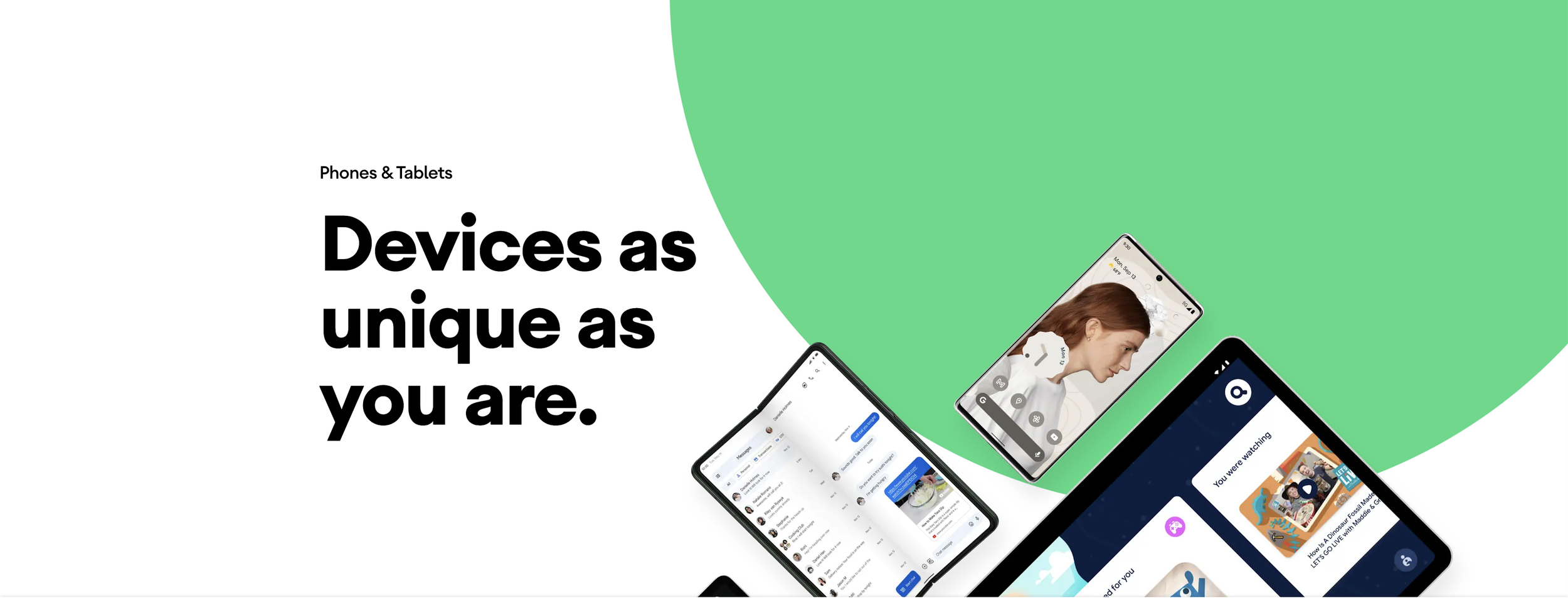
Meet your phone’s newest features.
The Ask.
Android assembled a small, cross-functional team to refresh content across Android.com.
The mandate was ambitious but straightforward: move fast, modernize the experience, and support a steady stream of new releases for the world’s most widely used operating system.
Speed mattered.
But so did the story.
The Challenge.
The existing workflow was largely design-led.
A layout would come first. Copy would then be written to fit the modules that had already been created.
That approach works reasonably well for simple pages.
Android is not simple.
With an ecosystem spanning devices, features, privacy updates, and constant product launches, writing copy after the fact meant some of the most important strategic thinking was happening too late.
The page had a shape.
But it didn’t always have a story.
The Insight.
When messaging is reactive to layout, it becomes ornamental.
If we wanted to explain Android’s value clearly, we needed to decide what the page meant before deciding what the page looked like.
That led to a simple principle:
Story first. Structure second.
Before anyone started pushing pixels, we needed to understand the narrative we were building.
My Solution.
I piloted a narrative-first ideation framework built around three questions:
WHY
Why does this page matter now?
WHAT
What does Android uniquely deliver?
HOW
How does the ecosystem bring that value to life?
Every project started with a positioning statement and rough “dummy copy” designed to stress-test the story before Design got involved.
That small change had a big effect.
Instead of writers simply filling modules, we were defining the meaning those modules needed to communicate.
I led the approach across multiple initiatives, including:
Full product pages
Feature launches
Modular updates supporting new releases
I worked closely with Designers and Creative Directors to align the narrative with visual hierarchy, with Project Managers to maintain speed without sacrificing clarity, and with Product Marketing Managers to make sure launch messaging translated naturally to the web.
The result was a healthier relationship between words and design.
Copy established the story.
Design amplified it.
Neither had to fight for attention.
Throughout the work, I also served as a steward of Android’s voice: clear, human, and quietly confident.
The Impact.
The framework:
Established a repeatable narrative-first workflow for a fast-moving team
Reduced rework by aligning messaging before wireframing
Strengthened clarity and cohesion across Android.com
Supported awareness and adoption of new product releases
But the most meaningful change was in the workflow itself.
We stopped designing pages and figuring out the story afterward.
We started building stories that users could actually navigate.


