

Your marketing, made easy.
The Ask.
For years, Shopify operated without a formal style guide.
That freedom had its advantages. Writers could move quickly, experiment, and make judgment calls. But over time, it also created inconsistencies—particularly across Shopify.com, where freelancers were responsible for much of the content without a shared framework for making brand decisions.
I was brought in to solve two problems:
Refresh the Marketing page, one of Shopify’s highest-traffic entry points.
Create a repeatable content framework that other designers and writers could use across the dotcom experience.
The bigger question was whether we could create consistency without taking away the flexibility that made Shopify’s voice work in the first place.
The Challenge.
How do you create a style guide for a company that historically didn’t want one?
And how do you do it when you’re barely a month into the job?
The answer wasn’t to come in with a giant rulebook and start policing commas.
Shopify didn’t need more rules. It needed a shared way of thinking.
The Insight.
Rather than introduce a traditional, top-down style guide, I started with the brand itself.
I talked with design directors, product marketers, and fellow writers to understand not just how Shopify communicated, but why certain choices worked.
From those conversations, I distilled a set of practical principles specifically for Shopify.com.
No vague guidance like “be bold” or “write with personality.”
Instead: clear do this, not that decisions tied directly to the needs of the business.
One directive from the CMO became the north star:
Be brutalist, but don’t be boring.
That meant cutting the excess, getting to the point, and saying the most exciting truth about the product as directly as possible.
In other words: less decoration, more conviction.
My Solution.
I turned those principles into a one-page working guide—a lightweight system designed to be useful in the real world, not something that would sit forgotten in a folder.
It clarified:
What dotcom copy should prioritize
How dotcom should sound different from other Shopify surfaces
Why those differences mattered
How writers could make better decisions without needing constant approval
Then I put the framework to work.
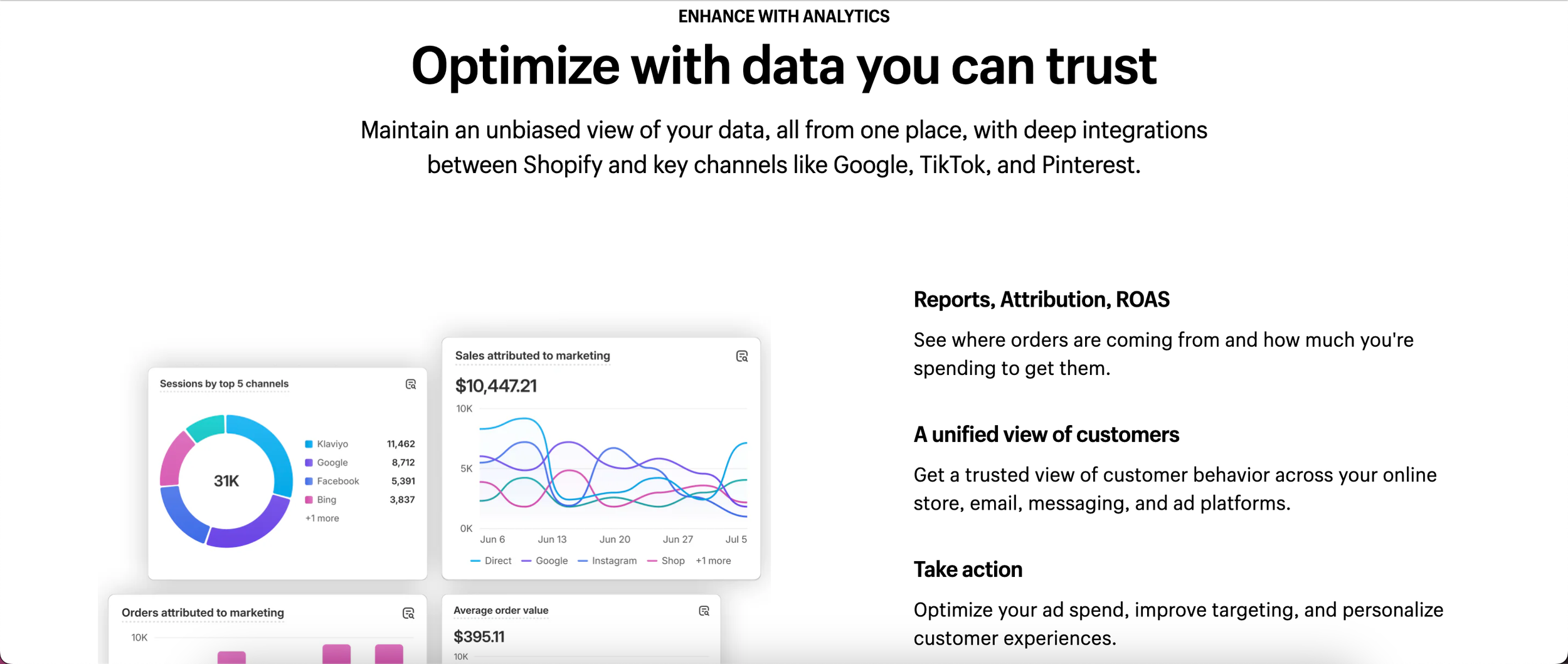
I rewrote the Marketing page line by line, transforming it from a collection of individual product messages into a cohesive story.
Every section had a job. Every headline earned its space. Every benefit was pushed closer to the surface.
The page became more than a refresh.
It became the proof that the system worked.
And, just as importantly, it gave the team a template they could carry forward.
The Impact.
The work delivered both a stronger page and a more scalable way of creating content.
Established Shopify’s first dotcom-specific content blueprint
Gave distributed freelancers a clear framework for making brand decisions independently
Increased traffic to the Marketing page
Created a more consistent content experience across Shopify.com
But the most important shift was the one to our team’s mindset.
We were no longer writing page by page.
We were building a system.